

- This event has passed.
Targeted Daytime Inspections Conducted in Kolfe Keranio Sub-City to Strengthen Tobacco Control Enforcement
March 12 @ 8:00 am - March 13 @ 5:00 pm
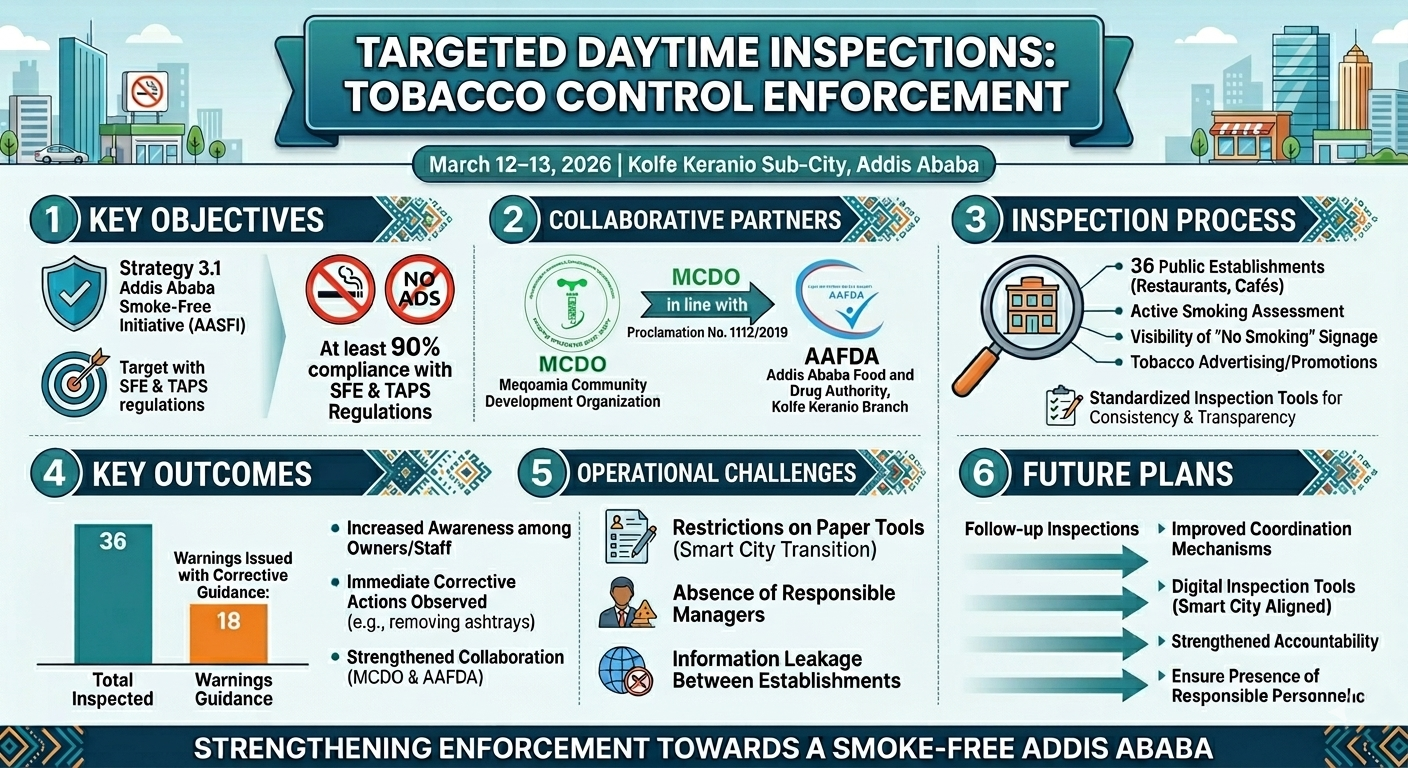
March 12–13, 2026 | Kolfe Keranio Sub-City, Addis Ababa
Targeted daytime inspections were successfully conducted in Kolfe Keranio Sub-City as part of Strategy 3.1 under the Addis Ababa Smoke-Free Initiative (AASFI). The activity aimed to strengthen systematic inspection and enforcement mechanisms to achieve at least 90% compliance with Smoke-Free Environment (SFE) and Tobacco Advertising, Promotion, and Sponsorship (TAPS) regulations.
The inspections were jointly implemented by Meqoamia Community Development Organization (MCDO) and the Addis Ababa Food and Drug Authority (AAFDA), Kolfe Keranio Branch, in line with the Food and Medicine Administration Proclamation No. 1112/2019.
A total of 36 public-serving establishments, including restaurants and cafés, were inspected. The exercise focused on assessing compliance with smoke-free regulations, including the presence of active smoking, visibility of “No Smoking” signage, and any evidence of tobacco advertising or promotional materials. Standardized inspection tools were used to ensure consistency, transparency, and accountability throughout the process.
As a result, 18 establishments were issued written warnings for non-compliance, accompanied by on-site corrective guidance. The findings indicate a moderate level of compliance, highlighting the need for continued monitoring and enforcement to achieve full regulatory adherence.
The activity also contributed to increased awareness among business owners and staff regarding tobacco control regulations. In several cases, immediate corrective actions were observed, including the removal of ashtrays and commitments to enforce smoke-free rules within premises. Strengthened collaboration between MCDO and AAFDA was also noted as a key outcome of the joint implementation.
However, the exercise also revealed several operational challenges, including restrictions on paper-based enforcement tools due to ongoing smart city transitions, absence of responsible managers during inspections, and information leakage between establishments, which affected the element of surprise in enforcement activities.
Moving forward, the program will focus on follow-up inspections, improved coordination mechanisms, and the introduction of digital inspection tools aligned with the smart city system. Strengthening accountability and ensuring the presence of responsible personnel during inspections will also be prioritized.
These efforts are expected to further enhance enforcement effectiveness and contribute to the broader goal of achieving a smoke-free Addis Ababa through sustained compliance with SFE and TAPS regulations.