
Addis Ababa, Ethiopia – MCDO
Introduction
Ethiopia is currently navigating a period of profound economic and social transformation. However, a growing public health crisis is quietly undermining this progress: the unregulated expansion of Khat consumption. Once limited to specific demographic groups and traditional ceremonies, Khat has now become a ubiquitous commodity, sold and consumed by everyone from young children to the elderly without any legal restrictions.
To safeguard the productivity and mental well-being of the next generation, Ethiopia must move toward a comprehensive national regulatory framework.
1. The Current Landscape of Khat Distribution
Ethiopia stands as a global leader in Khat production and export. While this provides short-term economic revenue, the lack of domestic regulation has led to an alarming rise in local dependency.
- Unchecked Expansion: Distribution has moved beyond traditional farming regions into every city, town, and rural village across the country.
- Vulnerable Demographics: High school and university students, workers in the transport sector, and unemployed youth are the primary demographics affected by this unregulated market.
2. Scientific Evidence and Health Risks (Based on EPHI 2021 Data)
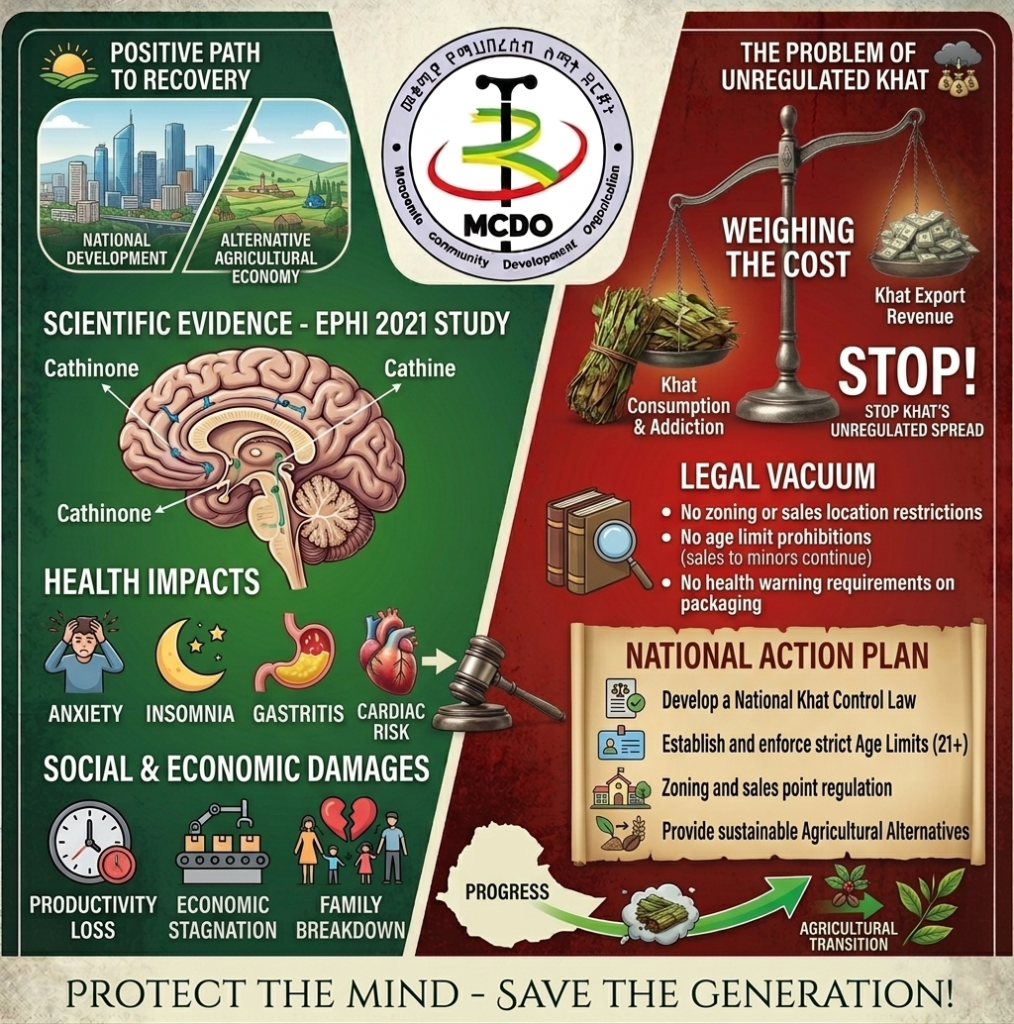
According to studies by the Ethiopian Public Health Institute (EPHI), the active components in Khat—Cathinone and Cathine—exert significant strain on the central nervous system.
Key Health Impacts include:
- Mental Health Disorders: Increased rates of severe anxiety, chronic insomnia, and a heightened risk of Psychosis.
- Non-Communicable Diseases: Elevated blood pressure, cardiac irregularities, and severe gastrointestinal issues like Gastritis.
- Oral Health: A direct correlation with periodontal diseases and an increased risk of oral cancer.
3. Socio-Economic Consequences
- Family Instability: Household incomes are frequently diverted to Khat, leading to a shortage of funds for basic needs such as nutrition and education, often resulting in domestic conflict and divorce.
- Lost Productivity: The “active hours” wasted during consumption and the subsequent “come-down” periods significantly drain the national labor force and economic output.
- The Gateway Effect: Khat often serves as a “gateway drug,” leading users toward secondary addictions such as alcohol and tobacco to manage the post-consumption effects.
4. The Legal Vacuum: A Call for Regulation
While Ethiopia has enacted strong regulations for tobacco and alcohol (Proclamation No. 1112/2019), Khat remains in a legal “grey zone”:
- There are no zoning laws governing where Khat can be sold.
- There is no age limit prohibiting sales to minors or adolescents.
- There are no mandatory health warnings on the product.
This regulatory gap allows vendors to set up shops directly adjacent to schools and residential areas, normalizing addiction for the youth.
5. Proposed Solutions (Call to Action)
To save the future of Ethiopia—our children and youth—we call upon the government and relevant stakeholders to:
- Enact a National Khat Control Law: Draft legislation that regulates the distribution chain and limits domestic consumption.
- Strict Age Restrictions: Criminalize the sale of Khat to anyone under the age of 21.
- Zoning and Licensing: Mandate that Khat outlets be located at a significant distance from schools, religious institutions, and public recreational spaces.
- Agricultural Transition: Provide incentives and support for farmers to transition from Khat to high-value food crops or alternative cash crops.
“Building a generation with a healthy mind starts with the strong regulatory laws we enact today!”
Protecting the Mind – Saving the Generation.
Author: Elias kalayu